Maybe students are not lazy. Maybe studying is simply losing the competition for their attention.
We often talk about studying as if the main enemy is laziness.
A student should study.
They don't.
So they must lack motivation, discipline or ambition.
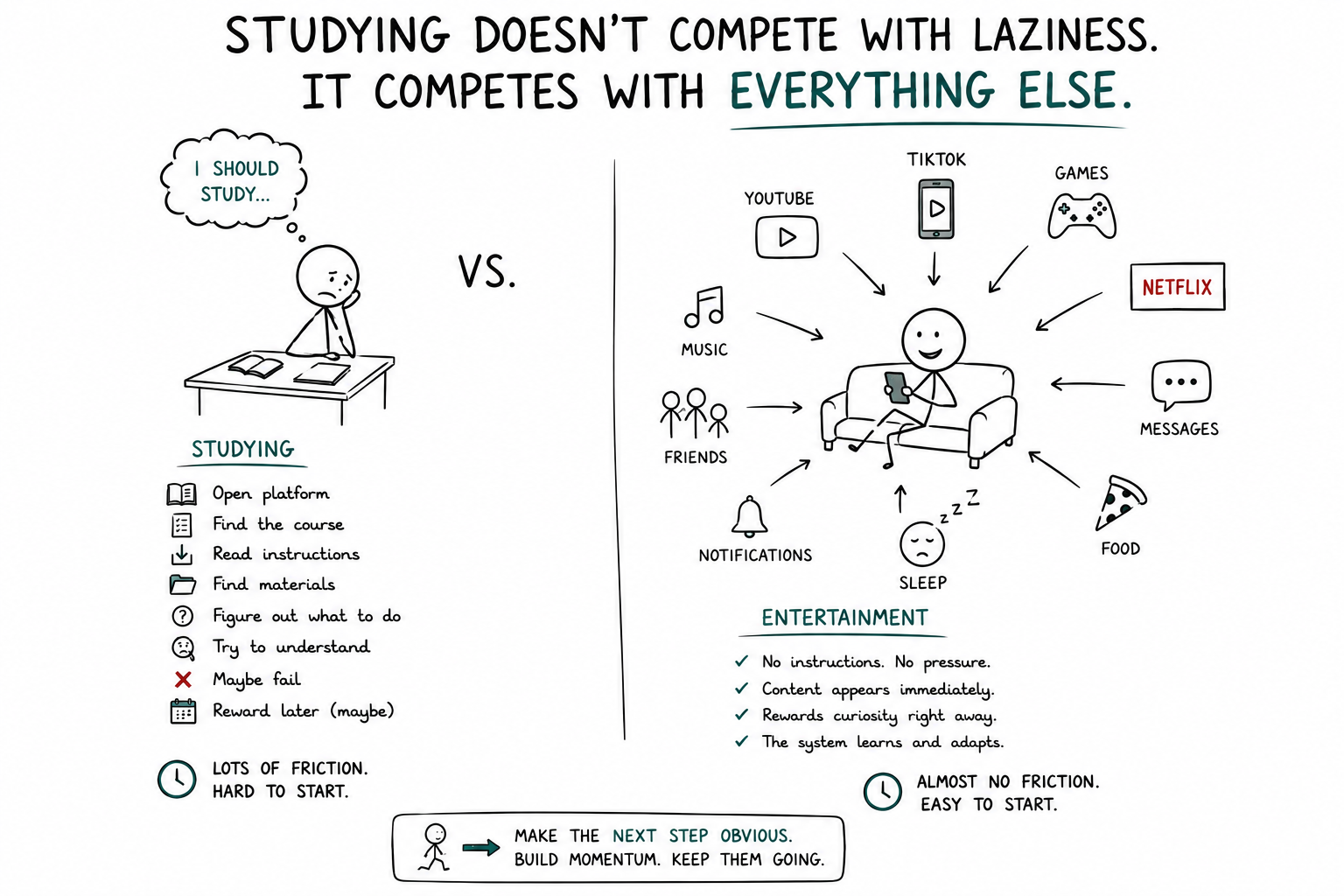
But imagine what studying is actually competing against.
TikTok.
YouTube.
Games.
Netflix.
Friends.
Messages.
Music.
Notifications.
Food.
Sleep.
And perhaps the most dangerous competitor of all:
Anything that feels easier right now.
Studying is not competing against doing nothing.
It is competing against some of the most carefully engineered experiences ever created.
And then we wonder why a PDF loses.
The Competition Has Changed
Think about what happens when a student opens TikTok.
There is no syllabus.
No instructions.
No learning objective.
No fear of getting something wrong.
No need to decide where to begin.
Open the app.
Content appears.
Swipe.
Another piece of content appears.
Swipe again.
The system learns.
It adapts.
It rewards curiosity immediately.
Now compare that with studying.
Open the learning platform.
Find the right course.
Find the assignment.
Read the instructions.
Download the material.
Figure out what you are supposed to know.
Decide where to start.
Try to understand something difficult.
Maybe fail.
Maybe feel stupid.
And perhaps receive a reward several weeks later in the form of a number.
Which experience would the human brain naturally choose?
This is not a fair fight.
"Just Be More Disciplined" Is Not a Product Strategy
Of course discipline matters.
Students eventually need to learn how to do things they do not immediately feel like doing.
But there is something strange about designing an experience that constantly loses the battle for attention and then blaming the user for losing interest.
Imagine if every other industry worked this way.
Your app is confusing?
The user should concentrate harder.
Your onboarding is terrible?
The user lacks discipline.
People keep abandoning your product?
Young people just don't have the attention span anymore.
We would laugh.
Yet education sometimes gets away with exactly this logic.
When students disengage, we often diagnose the student before examining the system.
Maybe we should reverse that.
The First 30 Seconds Matter More Than We Think
A student sits down.
They know they should study mathematics.
But what exactly should they do?
Read chapter six?
Do exercises?
Watch a video?
Review yesterday's mistakes?
Prepare for the exam?
For someone who already has strong study habits, this uncertainty may be trivial.
For someone who struggles to start, it can be enough to kill the entire session.
Because another option is sitting five centimeters away.
The phone.
And the phone does not ask:
"What would you like to accomplish during the next 45 minutes?"
It says:
"Here."
Something interesting.
Immediately.
That difference matters.
The hardest part of studying may not always be studying.
Sometimes it is crossing the distance between:
"I should study."
and
"I am studying."
Motivation Is Extremely Sensitive to Friction
We often imagine motivation as something stored inside a person.
You either have it or you don't.
But motivation is also shaped by the environment.
Every additional decision creates friction.
Every confusing instruction creates friction.
Every login creates friction.
Every unclear goal creates friction.
Every moment of:
"What am I supposed to do now?"
creates friction.
One piece of friction may not matter.
Ten pieces might.
Especially when the alternative requires almost none.
This creates an uncomfortable question for EdTech:
What if students don't need more motivation?
What if they need fewer reasons to quit?
Entertainment Understands the Next Action
The world's most engaging digital products are obsessed with one thing:
What happens next?
Finish an episode?
The next one starts.
Finish a video?
Another is waiting.
Play a game?
There is another objective.
Open social media?
There is already something new.
The user rarely has to stop and construct the experience themselves.
Learning platforms often do the opposite.
Here are your materials.
Here are your assignments.
Here is your calendar.
Good luck.
We provide access to learning.
But access is not the same thing as momentum.
A library contains almost everything you could possibly want to learn.
That does not mean everyone walking into one immediately starts studying.
Maybe Learning Platforms Need to Design for Momentum
This does not mean education should become TikTok.
Learning requires things entertainment often tries to eliminate.
Effort.
Concentration.
Frustration.
Repetition.
Failure.
Delayed gratification.
A good learning platform should not remove those things.
But it should ask a different question:
Where should the friction exist?
The friction should be in thinking.
Not in figuring out where to click.
The difficulty should be in solving the problem.
Not in deciding what to study.
The challenge should come from learning.
Not from starting.
That distinction is important.
Make the Next Step Obvious
Imagine a different learning experience.
A student opens the platform.
Instead of seeing everything they could do, they see what they should do next.
One small task.
Clear enough to begin immediately.
They attempt it.
Maybe they succeed.
Maybe they fail.
Either way, something happens.
The system reacts.
The next task changes.
Progress becomes visible.
The student does not have to repeatedly rebuild the learning process from scratch.
The system helps maintain momentum.
Not by making learning effortless.
But by making continuing easier than quitting.
That may be one of the most important design challenges in education.
APUOPE Is Interested in the Moment Before Learning
A lot of EdTech focuses on what happens after a student is already engaged.
Better explanations.
AI tutors.
Personalized exercises.
Adaptive difficulty.
Automated feedback.
Those things matter.
But there is an earlier problem.
What if the student never starts?
What if they upload the material but don't know what to do with it?
What if the task feels too large?
What if they fail once and disappear?
What if studying loses to YouTube before the first question even appears?
APUOPE is being built around the idea that learning systems should care about this moment too.
Not just:
How can we teach this student better?
But:
How can we help this student begin—and then keep going?
That means reducing unnecessary friction.
Making the next action clear.
Breaking intimidating goals into achievable steps.
Showing progress.
Adapting difficulty.
Using failure as information rather than punishment.
And creating enough momentum that another attempt feels natural.
The goal is not to make learning effortless.
The goal is to make effort easier to start.
Maybe Students Aren't Losing Motivation
Maybe motivation is the wrong place to start.
Maybe the student sitting on the couch scrolling through their phone is not making a conscious philosophical decision against education.
They are choosing between two experiences.
One says:
Come in. We already know what to show you next.
The other says:
You should really study. Figure it out.
Then we call the result laziness.
Perhaps the more useful question is:
Why did studying lose?
Because if learning is competing with everything else for attention, education cannot rely entirely on students choosing the harder option again and again through sheer willpower.
We need learning systems that understand human behaviour.
Systems that reduce the distance between intention and action.
Systems that make starting small.
Systems that make progress visible.
Systems that know what should happen next.
Not because students are lazy.
But because studying doesn't compete with laziness.
It competes with everything else.